


Customer Credentials
A leading pharmaceutical equipment manufacturer specializing in sterile processing and containment systems was developing an automated Rapid Transfer Port for isolator applications. These systems enable materials to move into controlled environments without compromising sterility.
In a highly regulated environment, consistent airflow is a fundamental requirement. Localized turbulence can disrupt containment performance, complicate validation, and increase contamination risk.
Before physical testing, the customer asked MN Engineering Solutions to understand the airflow around the motor-driven transfer mechanism and identify practical improvements.
The Challenge
The RTP used a motorized mechanism for material transfer. The motor sat close to the basket axis and partially inside a critical airflow path, raising concerns that it was disturbing the intended airflow pattern.
The team needed to determine whether motor placement was causing turbulence or recirculation, whether contamination control was affected, and which modification would provide the greatest benefit with minimal redesign.
Physical testing alone would have required multiple design iterations, additional prototypes, and extended development time. CFD analysis offered a way to evaluate the design before implementing changes.
MN Engineering Solutions Approach
MNES conducted a detailed CFD study in ANSYS Fluent for the RTP assembly and its surrounding isolator environment. The goal was to understand how the mechanical design interacted with the airflow system and identify implementable improvements.
The model assessed airflow distribution around the RTP, velocity variation near the motor and transfer basket, flow separation, turbulence generation, recirculation zones, and overall uniformity in the transfer area.
A digital model was evaluated under representative operating conditions, allowing engineers to trace airflow paths and quantify how individual components influenced performance.
Key Findings
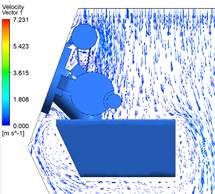
The CFD results confirmed that the motor location created a significant obstruction in the airflow path. The motor housing disturbed flow around the basket area, producing localized turbulence, recirculation zones, and eddy formation.
The RTP remained mechanically functional, but its motor arrangement introduced avoidable airflow disturbances that could compromise contamination-control performance.
The analysis established a clear root cause for the airflow issue and a focused direction for design improvement.
Engineering Recommendations
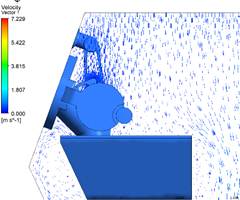
MNES recommended relocating the motor away from the basket axis and primary airflow path. A dedicated mounting arrangement would separate the drive system from the airflow-sensitive region while retaining the required mechanical function.
Where feasible, a more compact motor configuration was also recommended to further reduce obstruction and improve flow uniformity without a major change to the overall system architecture.
Results and Business Impact
The revised configuration reduced turbulence and eliminated several recirculation zones. Airflow became more uniform through the basket area, strengthening the controlled environment required for sterile material transfer.
Finding the issue early avoided costly late-stage revisions and reduced the need for multiple physical prototypes, shortening the development timeline and lowering engineering cost.
The customer entered formal validation with greater confidence in the RTP design and its contamination-control performance.
Conclusion
MN Engineering Solutions helped a pharmaceutical equipment manufacturer address a critical RTP airflow challenge through CFD analysis.
By identifying the effect of motor placement and supplying practical recommendations, MNES improved airflow uniformity, reduced contamination risk, and helped optimize the design before physical validation.